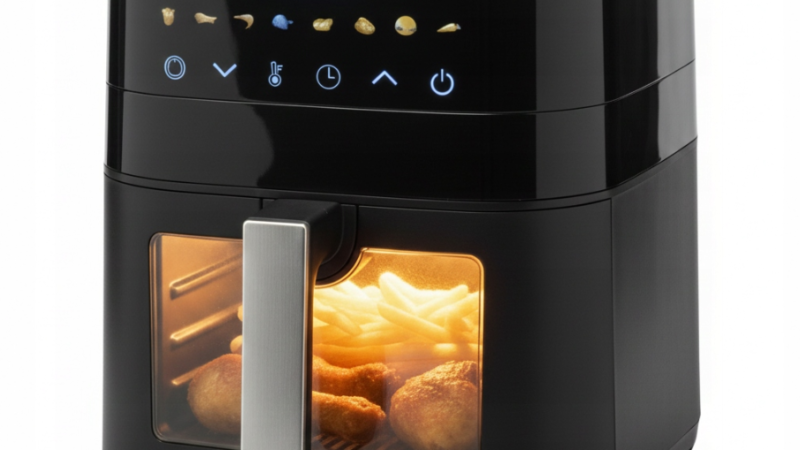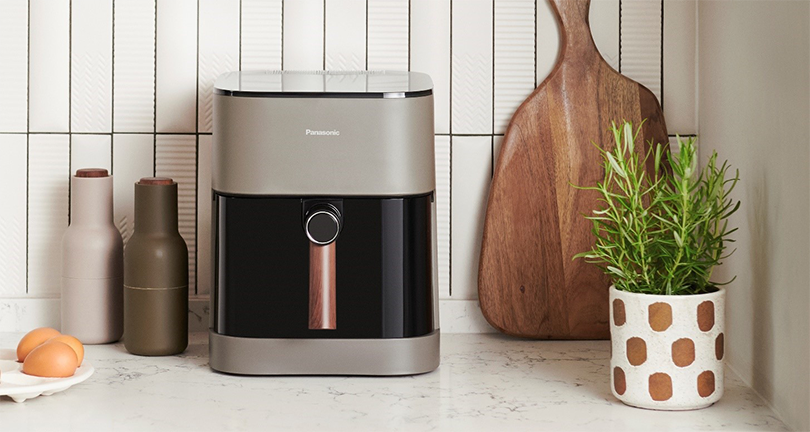
Quick answer: An air fryer is a small, powerful convection oven. A heating element at the top heats the air, and a fan directly above or behind it blows that hot air rapidly around the food. Because the cooking chamber is small and the air moves fast, heat reaches the surface of the food quickly. That dries the outside and browns it, which is what makes it crisp, using little or no oil. Most air fryers heat from about 80°C up to 200–240°C, depending on the model. “Rapid Air”, “TurboBlaze” and “Vortex” are brand names for the same basic idea.
Air fryers don’t fry anything. There’s no oil bath, and the “frying” effect comes from fast-moving hot air. Once you understand what’s going on inside, it’s much easier to see why shaking the basket, not overfilling it and drying food before cooking make such a difference. This guide explains how an air fryer works, what the brand names mean, and what that means for your cooking.
What’s Inside an Air Fryer
| Part | What it does |
|---|---|
| Heating element | A coiled metal element, usually above the basket, that heats the air (and radiates some heat straight onto the top of the food) |
| Fan | Sits just above or behind the element and pushes hot air down and around the food at high speed |
| Cooking chamber | A small enclosed space, so the air heats quickly and stays concentrated around the food |
| Basket or crisper plate | Holds food up off the bottom so hot air can flow underneath as well as over the top |
| Drawer | Catches drips and fat, and guides the airflow back up into the fan |
| Thermostat and controls | Switch the element on and off to hold the set temperature; the timer switches it off at the end |
The air goes round in a loop: the fan pushes hot air down the sides of the drawer, the shaped base turns it back up through the food, and it returns to the fan to be reheated. This happens many times a minute.
Why Food Goes Crispy Without Much Oil
Crispness comes from two things happening at the surface of the food:
- Moisture leaves the surface fast. Moving air carries water vapour away from the food much faster than still air does, the same way wind dries washing. A dry surface gets hotter than a wet one, which can’t go much above 100°C while water is still boiling off it.
- Browning reactions start. Once the surface is dry and hot enough (from roughly 140°C), the Maillard reaction and caramelisation start. These turn proteins and sugars into the brown colour and savoury flavour you get from roasting and frying.
Deep frying does the same two things using hot oil. An air fryer uses hot moving air instead. A little oil still helps, because it conducts heat well and helps the surface brown evenly, but you need a teaspoon or a tablespoon rather than a pan full. Our oil usage calculator suggests amounts by food.
Rapid Air, TurboBlaze, Vortex: What the Names Mean
Manufacturers give their airflow systems trademarked names. The details differ (fan speed, the shape of the base, the element layout), but they all work by fast-circulating hot air:
- Rapid Air is Philips’ name for its system. Philips invented the original air fryer, and many of its models have a ridged “starfish” base in the drawer that helps turn the airflow back up through the food.
- TurboBlaze is Cosori’s name for a range with a faster fan and higher heat setting, designed to brown food more quickly.
- Vortex is the name of Instant Brands’ air fryer range (the makers of Instant Pot), rather than a separate technology.
- Max Crisp is a high-heat setting on some Ninja models, for frozen food.
In practice, the size of the basket, how evenly the air reaches the food and how accurate the thermostat is matter more than the name on the box. Check your manual for your model’s actual temperature range. Most basket air fryers go from about 80°C to between 200°C and 240°C.
Basket vs Oven-Style vs Dual Drawer
| Type | How the air moves | Good for | Watch out for |
|---|---|---|---|
| Single basket | Down through a small drawer: very concentrated | The crispest results; chips, wings and frozen food | Needs shaking; limited capacity |
| Dual drawer | Two separate chambers, each with its own element and fan | Cooking two foods at different settings and finishing together | Each drawer is smaller than it looks |
| Oven-style (with shelves) | Across shelves in a larger box | Bigger batches, baking, dehydrating, rotisserie | Top shelf cooks faster; swap trays halfway |
| Lid-type or multi-cooker | Down from a lid over a pot | One appliance for pressure cooking and air frying | Smaller crisping area |
Choosing one? Our air fryer size guide and how to choose an air fryer go through the options.
Why Air Fryers Are Usually Cheaper to Run
An air fryer typically uses 1,000–2,000 W while the element is on, similar to an oven element. It’s usually cheaper overall because it heats a much smaller space, so it gets up to temperature in a few minutes and cooks most foods faster. The thermostat also switches the element off once the set temperature is reached, so average power use is lower than the rated wattage. See how many watts an air fryer uses and air fryer vs oven running costs for the sums.
What This Means for Your Cooking
- Don’t overfill. Air needs to reach the surface of each piece. A packed basket steams rather than crisps. Cook in batches.
- Shake or turn halfway. The top gets the most direct heat, so moving food around evens out the browning.
- Dry food first. Pat chips, vegetables and meat dry. Surface water has to boil off before browning can start.
- Use less heat than the oven. Moving air transfers heat faster, so drop oven temperatures by about 20°C and check early. Our oven to air fryer converter helps.
- Preheat for crisp coatings. A few minutes’ preheat helps breaded and frozen foods. More in do you need to preheat an air fryer?
- Weigh down liners and foil. The fan is strong enough to lift loose paper onto the element.
- Keep the element clean. Fat splashed onto the element causes smoke. See why is my air fryer smoking?
Common Myths
| Myth | Reality |
|---|---|
| “Air fryers fry food.” | They roast and bake with fast hot air. The result can be similar to frying, but the process is convection cooking. |
| “They work like a microwave.” | No. They heat with an ordinary electric element and hot air, the same as a conventional oven, not with microwaves. |
| “You can’t use any oil.” | You can, and a little often helps browning. Just avoid low smoke-point oils at high heat, and don’t use aerosol sprays on non-stick coatings if the manufacturer says not to. |
| “Bigger is always better.” | A half-empty large basket works fine, but an overfilled small one doesn’t. Match the size to how much you usually cook. |
| “The brand’s airflow technology makes a huge difference.” | It can help at the margins, but loading, shaking and drying the food matter more for most results. |
Frequently Asked Questions
How does an air fryer work?
A heating element heats the air inside a small chamber, and a powerful fan circulates that hot air rapidly around the food. That dries and browns the surface, making it crisp with little or no oil.
Is an air fryer just a convection oven?
Essentially, yes. It’s a compact convection oven with a stronger fan and a much smaller cooking space, which is why it heats up and crisps food faster.
What is Rapid Air technology?
Rapid Air is Philips’ name for its air fryer airflow system. It uses the same principle as other air fryers: hot air from an element, circulated quickly by a fan, often helped by a ridged base that directs the air up through the food.
What temperature do air fryers reach?
Most basket air fryers range from about 80°C up to between 200°C and 240°C, depending on the model. Check your manual for the exact range.
Do air fryers use microwaves?
No. They cook with an ordinary electric heating element and hot air, like a conventional oven.
Why does my air fryer need shaking?
The top of the food gets the most direct heat. Shaking or turning halfway exposes all sides to the airflow so food browns evenly.
Learn more: how many watts an air fryer uses · what size air fryer do I need? · smart air fryers