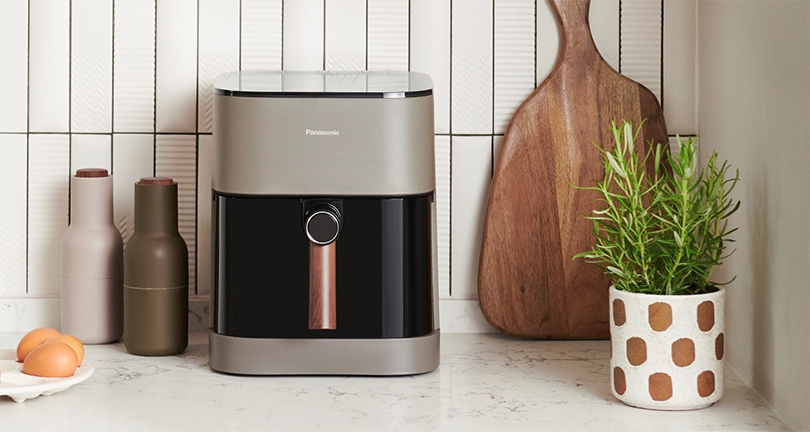
“Rapid air technology” appears on the packaging of almost every air fryer sold today — but what does it actually mean, and why does it produce food that resembles deep-frying using a fraction of the oil? This guide explains the science plainly.
The Basic Principle: Convection, Amplified
An air fryer is a very compact, very powerful convection oven. A conventional fan oven circulates heated air around a large cooking chamber. An air fryer takes this to an extreme: the chamber is tiny, the fan is powerful, and the heating element is positioned to create rapid circular airflow around the food basket.
The result: hot air moves across food many times faster than in a conventional oven. This is why air fryers cook 20–30% faster than ovens at equivalent temperatures — and why our oven to air fryer converter reduces cooking times by 20% by default.
Why “Rapid Air”?
“Rapid Air Technology” is a trademarked term coined by Philips, who introduced the first commercially successful air fryer in 2010. Their patented StarFish design directed airflow in a star-shaped pattern around the basket for maximum even coverage. Other manufacturers developed similar systems under different names — “360° Hot Air Circulation”, “TurboStar”, “AirCrisp” — but the underlying principle is identical.
The Maillard Reaction: The Source of the Crunch
The crispy, golden-brown exterior that makes air-fried food satisfying is the result of the Maillard reaction — named after French chemist Louis-Camille Maillard who described it in 1912. It is a reaction between amino acids and reducing sugars that occurs above approximately 140°C (285°F).
The Maillard reaction produces hundreds of flavour compounds and the characteristic brown colour of grilled, roasted, and fried food. It is what makes bread crust taste different from the interior, and why a seared steak has complex flavours that a poached steak lacks.
🔬 Science note: The Maillard reaction requires a relatively dry surface. This is why patting food dry before air frying dramatically improves browning — wet surfaces must evaporate moisture before browning can begin, requiring higher effective temperatures and more time.
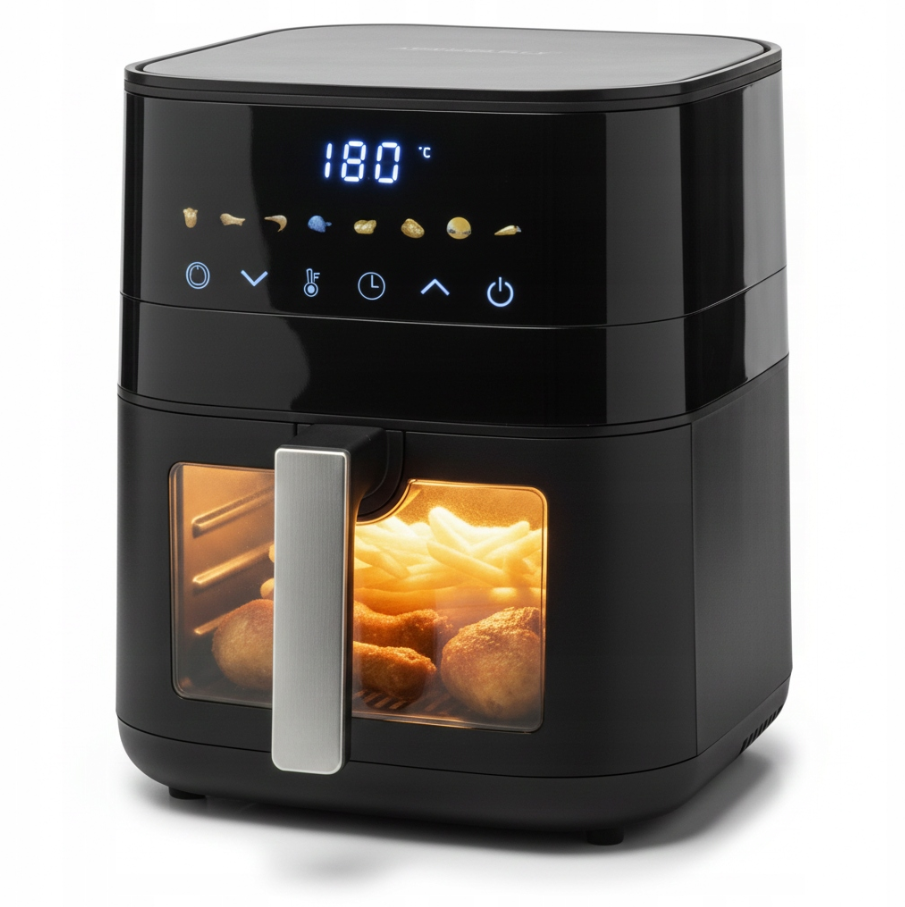
How Air Fryers Produce Maillard Browning Without Deep Oil
Deep frying submerges food in oil at 175–190°C. The oil conducts heat across the entire food surface simultaneously and instantly, maintaining consistent Maillard conditions. An air fryer achieves comparable browning through velocity rather than conduction — by forcing superheated air at high speed across the food surface, it creates heat transfer rates that approach direct oil contact.
The basket’s perforated design is critical: it allows air to circulate beneath the food as well as above and around it. A small amount of oil (a light spray or brush) still improves results by increasing thermal contact and dispersing heat-sensitive flavour compounds — but it is not required for the Maillard reaction to occur.
Air Fryer vs Conventional Oven: The Numbers
| Factor | Conventional Oven | Fan Oven | Air Fryer |
|---|---|---|---|
| Air velocity | Low | Medium | Very high |
| Chamber size | 40–80L | 40–80L | 2–10L |
| Preheat time | 10–15 mins | 8–12 mins | 2–3 mins |
| Speed vs oven | 1× baseline | 1.1–1.2× | 1.25–1.4× |
| Energy use | 2–3 kW | 2–3 kW | 0.8–1.5 kW |
The Role of Basket Design
The perforated metal basket elevates food off a solid surface, allowing air circulation from below. This prevents the bottom surface from steaming — which would block Maillard browning and produce pale, soft patches. The small perforations are sized to allow maximum airflow while preventing small food pieces from falling through.
Overcrowding the basket destroys results: when food pieces touch, they block airflow to each other’s surfaces, creating steam zones that prevent browning. Our cooking time calculator accounts for this — always cook in a single layer for best results.
Why Some Foods Do Not Crisp Well
Understanding the science explains the limitations. Wet batters (fish and chip shop batter) do not work because the batter drips before it can set. Foods with very high water content release too much steam to achieve surface dryness. Very delicate items get blown around by the fan and cook unevenly.
For these foods, a conventional oven or frying pan remains the better tool. For the majority of proteins, vegetables, and frozen foods, the air fryer consistently outperforms both in speed and texture.